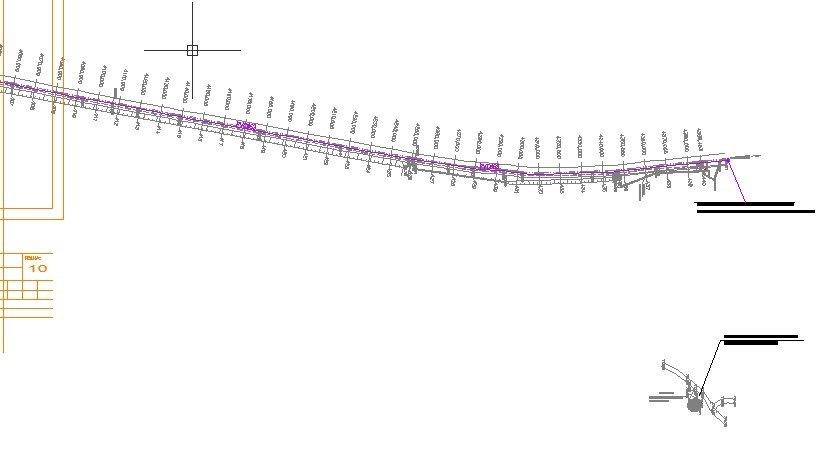
Gravity Water Supply Pipeline Project: Arcada Fountain – Escurquela
Municipality of Sernancelhe
Introduction
This article presents the technical engineering project for the design and dimensioning of a gravity-fed pipeline established between Fonte Arcada and Escurquela, in the Municipality of Sergipe. The infrastructure was designed with the sole purpose of supplying water to the Escurquela reservoir, ensuring the efficient transport of water without intermediate distribution functions, thus guaranteeing the fulfillment of the hydraulic conditions required for the system.
Context and Need
The project was based on the Preliminary Study of the “Low Pressure” Water Distribution Systems of the Southern Douro Valley (VOLUME VI Municipality of Sernancelhe). The intervention is justified by the need to establish a resilient water transport system in a territory with a complex geological environment. The route crosses extremely rugged terrain, with steep slopes and natural soil consisting predominantly of hard to very hard rock, requiring technical solutions that guarantee the stability and functionality of the network in the long term.
Summary of the Project Completed
The technical solution implemented focused on the efficiency of gravity-fed flow and adaptation to the terrain constraints.
Network and Materials: The pipeline was primarily constructed of rigid PVC, class 1.0 MPa. At critical points, such as bridge crossings and aqueducts where the piping is exposed, ductile cast iron was used to ensure the necessary strength.
Hydraulic Dimensioning: The calculation of continuous head losses was performed using the Manning-Strickler formula for a design flow rate of 0.30 l/s, ensuring that flow velocities are maintained within regulatory limits.
Strategic Implementation: The route follows existing roads to avoid “grass cutting” areas in rocky soil. The pipeline was installed at an average depth of 1.20 m to ensure passage under numerous local aqueducts without compromising functionality.
Stability and Safety: In sections with slopes greater than 15%, plain concrete anchoring and tie blocks were designed to resist impulses and ensure the immobilization of the pipeline. Control and Protection Devices: The system includes buried shut-off valves for isolating sections, single-acting automatic air vents (SAVs) for steady-state air expulsion, and bottom discharge valves (D=63 mm) for cleaning and maintenance operations.
Quality Control: Before commissioning, the network undergoes leak tests at one and a half times the maximum service pressure (minimum 900 kPa), followed by washing and disinfection operations.
Would you like to explore other hydraulic engineering projects in our portfolio? Consult our completed case studies or, if you would like detailed technical information about our engineering solutions, contact us directly through the form available on our website.
Discover how we can make your project a reality.
Get in touch with us and let’s create something extraordinary together.