Gravity Pipeline Project: Carregal – Forca
Municipality of Sernancelhe
Introduction
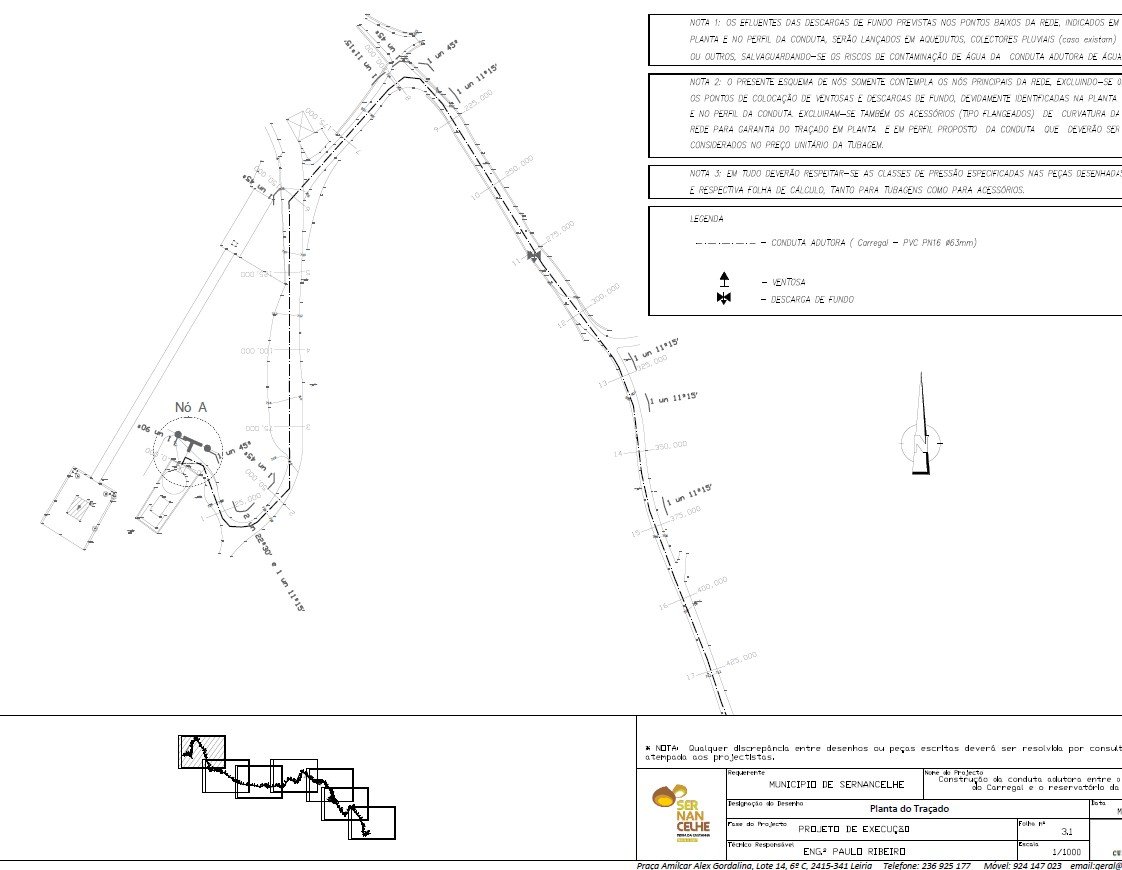
This technical project refers to the design and dimensioning of a gravity-fed pipeline established between the Carregal reservoir and the Forca reservoir, located in the Municipality of Sernancelhe. The infrastructure was designed with the sole purpose of conveyance, ensuring the efficient transport of water between the two storage points without direct distribution functions along the route.
Context and Need
The need for this project arises from the urgent need to guarantee a continuous supply to the Forca reservoir, optimizing the existing water transport system. The technical challenge lay in the complexity of the region’s geological environment, characterized by rugged terrain and steep slopes, where the natural soil is predominantly composed of hard to very hard rock. It was therefore essential to design a route that ensured a balance between flow velocities and operating pressures, respecting the morphological constraints of the terrain.
Summary of the Project Completed
The intervention consisted of the comprehensive development of the water supply network, focusing on the following technical aspects:
- Materials and Sizing: The network was primarily constructed using rigid PVC (1.6 MPa class), with ductile cast iron used for bridge and aqueduct crossings. Hydraulic sizing was based on the Manning-Strickler formula for a flow rate of 0.30 l/s, ensuring gravity-fed operation.
- Strategic Implementation: The route followed existing dirt roads, paved roads, and asphalt, avoiding cross-country areas to optimize execution in rocky soil. The pipeline was installed at a minimum depth of 1.00 m, following the slope of the streets to avoid high points and air accumulation.
- Safety and Stability: Due to slopes exceeding 15% in certain sections, anchoring and tie blocks were designed in plain concrete to resist longitudinal forces and impulses at singular points in the network.
- Control and Protection Devices: The system was equipped with full-bore shut-off valves for section isolation, triple-acting automatic air vents for air expulsion, and bottom discharge valves (D=63 mm) for cleaning and maintenance operations.
- Quality Control: The project established rigorous verification protocols, including leak tests at pressures one and a half times higher than the maximum service pressure (minimum 900 kPa), disinfection operations, and final hydraulic operation tests.
Would you like to see other hydraulic infrastructure projects in our portfolio? Explore our completed projects or, if you are interested in learning more about our technical solutions, contact us directly through the form available on our website.
Discover how we can make your project a reality.
Get in touch with us and let’s create something extraordinary together.

ENVISQUANTIS, LDA
Links
Follow us on social media:
Copyright © 2025 Envisquantis, LDA